Pages

Showing posts with label WiMAX ebook. Show all posts

Monday, December 20, 2010

Wiley: Mobile WiMAX


Format : PDF
ISBN: 047051941X
Pub Date: April 04, 2008


The first book to cover one of the hottest subjects in wireless communications today, Mobile WiMAX.

* Summarises the fundamental theory and practice of Mobile WiMAX
* Presents topics at introductory level for readers interested in understanding communication and networking knowledge for Mobile WiMAX, whilst addressing advanced / specialised subjects related to Mobile WiMAX
* Contains the latest advances and research from the field and shares knowledge from the key players working in this area

Chapter 1 updates Mobile WiMAX status and standards; Chapters 2-6 are related to physical layer transmission; Chapters 7-12 deal with MAC and networking issues; Chapters 13-14 discuss relay networks for mobile WiMAX; and Chapters 15-19 present multimedia networking for mobile WiMAX and application scenarios.

Ideal for Mobile WiMAX R&D/practicing engineers (systems, applications and services, field, terminal, IC design, integration), business development professionals, academic researchers. Graduate students conducting research and graduate students studying in mobile WiMAX and next generation wireless communications. Undergraduate students studying mobile WiMAX related subjects.


Download here

WiMAX: Standards and Security

ISBN:  9781420045239
ISBN 10:  1420045237
Publication Date:  September 07, 2007
Number of Pages:  280 


Format : PDF


As the demand for broadband services continues to grow worldwide, traditional solutions, such as digital cable and fiber optics, are often difficult and expensive to implement, especially in rural and remote areas. The emerging WiMAX system satisfies the growing need for high data-rate applications such as voiceover IP, video conferencing, interactive gaming, and multimedia streaming. WiMAX deployments not only serve residential and enterprise users but can also be deployed as a backhaul for Wi-Fi hotspots or 3G cellular towers. By providing affordable wireless broadband access, the technology of WiMAX will revolutionize broadband communications in the developed world and bridge the digital divide in developing countries.
Part of the WiMAX Handbook, this volume focuses on the standards and security issues of WiMAX. The book examines standardized versus proprietary solutions for wireless broadband access, reviews the core medium access control protocol of WiMAX systems, and presents carriers’ perspectives on wireless services. It also discusses the main mobility functions of the IEEE 802.16e standard, describes how to speed up WiMAX handover procedures, presents the 802.16 mesh protocol, and surveys the testing and certification processes used for WiMAX products. In addition, the book reviews the security features of both IEEE 802.16 and WiMAX.
With the revolutionary technology of WiMAX, the lives of many will undoubtedly improve, thereby leading to greater economic empowerment.


Download here

Sunday, December 19, 2010

WiMax Operator's Manual: Building 802.16 Wireless Networks, 2nd Edition


Publisher: Apress; 2 edition
Language: English
ISBN: 1590595742
Paperback: 210 pages
Data: November 16, 2005
Format: PDF


This second edition includes most of the material from the first edition, plus new discussions about the ultra-fast mobile telephone standard High Speed Downlink Packet Access (HSDPA) and the Ultra Wideband (UWB) technology. Other topics include mobile voice and entertainment, new backup systems, and changes to DSL technologies.
The book addresses the planning, construction, and day-to-day operation of a standards-based broadband wireless network. It examines the advantages of broadband wireless and how it constitutes an ideal solution. It also explains the unique difficulties, challenges, and limitations of broadband wireless.
This book illustrates how to plan and run networks, and indicates which specialized services should be secured. Youll learn how to plan a successful, profitable broadband wireless network in a short amount of time.

Download here

WiMAX:Technologies Performance Analysis and QoS


CRC Press | ISBN: 9781420045253 | 196 pages | English | 3.97 MB

Introduction
A typical wireless communication system contains several signal processing steps. In addition to the radio front-end, radio systems commonly incorporate several digital components such as a digital baseband processor, a media access controller, and an application processor. An overview of such a system is illustrated in Figure 1.1.
Most wireless systems contain two main computational paths, the transmit path and the receive path. In the transmit path, the baseband processor receives data from the media access control (MAC) processor and performs
• Channel coding
• Modulation
• Symbol shaping
before the data is sent to the radio front-end via a digital to analog converter (DAC). In the receive path, the RF signal is first down-converted to an analog baseband signal. The signal is then conditioned and filtered in the analog baseband circuitry. After this the signal is digitized by an analog to digital converter (ADC) and sent to the digital baseband processor that performs
• Filtering, synchronization, and gain control
• Demodulation, channel estimation, and compensation
• Forward error correction (FEC)
before the data is transferred to the MAC protocol layer.
The aim of this chapter is to give an introduction to the programmable baseband processors suited for WiMAX systems and other multimode wireless systems. Related processing challenges that influence the design of such processors are also highlighted. A mapping of the WiMAX mode IEEE
802.16d onto a programmable processor is used as an example to illustrate the computational requirements on a WiMAX system.

Download here

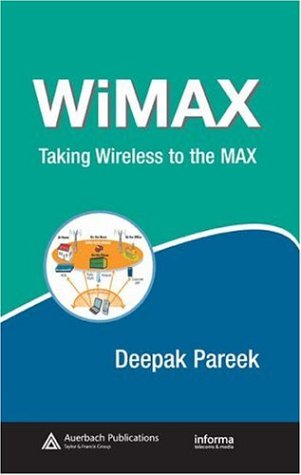
WiMAX: Taking Wireless to the MAX

  • Hardcover: 384 pages
  • Publisher: Auerbach Publications; 1 edition (May 30, 2006)
  • Language: English
  • ISBN-10: 0849371864
  • ISBN-13: 978-0849371868


With market value expected to reach $5 billion by 2007 and the endorsement of some of the biggest names in telecommunications, World Interoperability for Microwave Access (WiMAX) is poised to change the broadband wireless landscape. But how much of WiMAX’s touted potential is merely hype? Now that several pre-WiMAX networks have been deployed, what are the operators saying about QoS and ROI? How and when will device manufacturers integrate WiMAX into their products? What is the business case for using WiMAX rather than any number of other established wireless alternatives? WiMAX: Taking Wireless to the MAX examines the evolution of wireless, broadband, and the wireless broadband landscape with exhaustive coverage of technological advances and evolving topologies. It sets the tone for the journey towards untouched wireless heights - WiMAX. The author builds a complete understanding of Broadband Wireless Access (BWA) Technologies, elaborating on past developments, present needs and uses, and future trends and markets. He lays out a road map to the future and articulates present and future applications and models of BWA with focus on WiMAX. The book also provides a detailed discussion on the advanced technologies central to the existence of WiMAX. It presents strategies for building the case for WiMAX and achieving success for the different players, including service providers and equipment manufacturers. An increasing demand for access to information anytime, anywhere has led to explosive growth in access and wireless technologies. The trend has created new competitive threats as well as new opportunities in every walk of life. The task, then, is to turn possibilities into realities and provide solutions that enable anywhere, anytime access to information and applications at low cost and with a small investment. Taking a coherent and fact-based approach, this book explores the space between what is known and available and what industry needs.

Download here

Wimax - A Wireless Technology Revolution

  • ISBN: 0849370590
  • Language: English
  • Release Date: 2007-10-19 00:00:00
  • Category: Wireless Network
 The demand for broadband connectivity is growing rapidly, but cannot be met effectively by existing wireline technology. WiMAX has the potential to provide widespread Internet access that can usher in economic growth, better education and healthcare, and improved entertainment services. Examining the technology's global development and deployment activities, WiMAX: A Wireless Technology Revolution presents its unique features and evaluates its revolutionary approach over contemporary technologies.

The book covers the mission, product, and services of WiMAX, as well as specific features such as security and mobility. It discusses the implementation of the IEEE 802.16 standard and also explores how WiMax stacks up to 3G and 4G and the economic and opportunity costs. This reference also analyzes the future prospects of WiMAX and its contribution to the wireless and mobile communication technology field. It is a must-have resource for those who are either intrigued or involved with this standards-based technology that has the ability to provide high-throughput broadband connections over long distances.


Download here

Tuesday, November 30, 2010

Fundamentals of WiMAX (pdf)

Authors: Jeffrey G. Andrews, Arunabha Ghosh, and Rias Muhamed
Publisher: Prentice Hall

Book description
The Definitive Guide to WiMAX Technology WiMAX is the most promising new technology for broadband wireless access to IP services. It can serve an extraordinary range of applications and environments: data, voice, and multimedia; fixed and mobile; licensed and unlicensed. However, until now, wireless professionals have had little reliable information to guide them. Fundamentals of WiMAX is the first comprehensive guide to WiMAX--its technical foundations, features, and performance. Three leading wireless experts systematically cut through the hype surrounding WiMAX and illuminate the realities. They combine complete information for wireless professionals and basic, accessible knowledge for non-experts. Professionals will especially appreciate their detailed discussion of the performance of WiMAX based on comprehensive link- and system-level simulations. Whether you're a wireless engineer, network architect, manager, or system designer, this book delivers essential information for succeeding with WiMAX--from planning through deployment. Topics include Applications, history, spectrum options, technical and business challenges, and competitive technologies of WiMAX 802.16 standards: physical and MAC layers, channel access, scheduling services, mobility, advanced antenna features, hybrid-ARQ, and more Broadband wireless channels: pathloss, shadowing, cellular systems, sectoring, and fading--including modeling and mitigation OFDM: from basic multicarrier concepts to synchronization, PAR reduction, and clipping MIMO: Multiple antennas, spatial diversity, beamforming, and a cutting-edge treatment of the use of MIMO in WiMAX OFDMA: multiple access, multiuser diversity, adaptive modulation, and resource allocation Networking and services aspects: architecture and protocols for IP QoS, session management, ecurity, and mobility management Predicting performance using link-level and system-level simulations WiMAX network architecture: design principles, reference models, authentication, QoS, and mobility management About the Author
Jeffrey G. Andrews is an assistant professor at The University of Texas at Austin. He has developed CDMA systems for Qualcomm and consulted with many organizations including the WiMAX Forum, Microsoft, and NASA. He is a recipient of the NSF CAREER Award and holds a Ph.D. from Stanford University.
Arunabha Ghosh, a principal member of technical staff at AT&T Labs, specializes in wireless communication theory and signal processing and has been involved in standardization efforts in the WiMAX Forum. He holds a Ph.D. from the University of Illinois at Urbana-Champaign.
Rias Muhamed is a lead member of technical staff at AT&T Labs. He has led several research and technology assessment projects in fixed wireless broadband at AT&T Labs. He is a senior member of the IEEE and holds an M.S. from Virginia Tech.

Download here

Friday, November 26, 2010

3G Evolution: HSPA and LTE for Mobile Broadband

Stefan Parkvall, Johan Skold, Per Beming
ISBN: 012372533X
October 2007
Third-generation (3G) cell-phone technologies have been a long time in coming. But they are with us now and are beginning to make a difference in cellular service, particularly in non-voice applications such as e-mail, Internet access, and video. The 3G technologies include the WCDMA system with its high-speed packet access (HSPA) upgrades, Qualcomm’s cdma2000 technology with its EV-DO systems and Rev A and Rev B upgrades, as well as forthcoming 4G technology known as Long Term Evolution (LTE). With 3G now upon us, it is more important than ever to understand these new systems, how they are designed and how they are applied. This book does a good job of covering this subject.
The primary emphasis is on the ITU’s International Mobile Telecommunications 2000 standard that is developed and maintained by the Third Generation Partnership Project (3GPP). This is a WCDMA system with HSPA upgrades. The evolving LTE technology that will eventually replace the WCDMA system is covered. The book focuses on how to increase the data speed of cellular systems and all the related issues. This is dealt with at the mathematical level but the explanations are very clear. The book includes a great introduction to OFDM and multiple antenna technologies if you are still not up to speed on these essential wireless methods.
A huge portion of the book is devoted to the emerging HSPA technologies slowly being implemented in the US and worldwide. They make the WCDMA systems of today faster and more desirable. The remainder of the book is devoted to the LTE system. A good introduction if you are starting from scratch and a good reference if you are working in this field. I really liked the chapter on other wireless communications systems. A great summary and overview of cdma2000, Rev A and B, Ultra Mobile Broadband (UMB), WiMAX, and the 802.20 system. A big downer is that there’s no coverage of the Chinese TD-SCDMA system, which is becoming a big part of 3G. Nonetheless, it is still recommended.